Summary:
You had a tree taken down. Maybe it was storm damage, maybe it was just time. Either way, the tree is gone — and now there’s a stump sitting in your yard that you’re mowing around every week, quietly hoping it’ll deal with itself. It won’t. What most Nassau County homeowners don’t realize is that what happens after the tree comes down matters just as much as the removal itself. This page covers what professional stump grinding actually involves, where DIY attempts typically go sideways, and what you should expect from a qualified stump grinder service before anyone fires up a machine on your property.
Professional Stump Grinder Service vs. Renting Equipment Yourself
The rental option looks appealing on paper. You find a stump grinder at a home improvement store, pay the daily rate, and handle it yourself. But the math changes quickly once you factor in delivery fees, the cost of a truck or trailer if you don’t own one, safety gear, and the better part of a day doing physically demanding work with equipment you’ve never used. For a single stump, the gap between rental cost and professional service is often smaller than people expect — and the risk profile is completely different.
Professional stump grinding isn’t just about having a bigger machine. It’s about knowing what’s underneath your yard before the grinding starts, selecting the right equipment for the specific stump and property layout, reaching the depth that actually prevents regrowth, and leaving the site clean when the job is done. Those aren’t things that come with the rental.
Stump Grinding Cost: Rental vs. Professional Service in Nassau County
Stump grinder rental rates average around $300 per day nationally, with a range from roughly $85 to $400 depending on the machine size. That’s before delivery, which typically adds $25 to $75. If you don’t own a truck or trailer capable of hauling the equipment, that’s another rental on top of it. By the time you’ve accounted for everything, a single-stump DIY job can cost $400 or more — and that’s before anything goes wrong.
We charge between $100 and $400 per stump across Nassau County, though larger stumps or more complex jobs will land higher. Long Island’s labor rates trend above national averages, but you’re getting a complete service: site assessment, the right equipment for your specific situation, grinding to proper depth, and full cleanup afterward. No hauling, no guesswork, no half-day of physical labor.
What most people don’t think about is what “going wrong” actually looks like with a DIY rental. Nassau County has some of the densest underground utility infrastructure on Long Island — gas lines, water mains, electrical conduit, telecom cables. Before any stump grinding begins, there’s a federal requirement to call 811 and have the area marked. We know this and build it into our process. Renters frequently skip it, not because they’re careless, but because they simply don’t know it’s required. A struck gas line is not a recoverable mistake.
There’s also the matter of what consumer-grade rental equipment can actually do. Most machines available at home improvement rental counters are smaller, less powerful versions of professional grinders. They can handle modest stumps in open, accessible areas — but they often can’t reach the 8 to 12 inches below grade that’s needed to prevent regrowth or allow for future planting. You might grind the visible stump down, feel like the job is done, and find new shoots coming up within a season. Norway maple, which is extremely common throughout Nassau County, is particularly aggressive about resprouting from root material that wasn’t fully addressed.
What the Full Stump Grinding Process Actually Looks Like
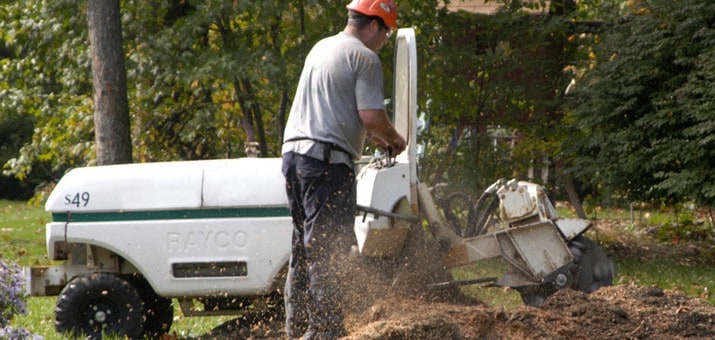
Professional stump grinding isn’t just showing up with a machine. Before any grinding starts, we conduct a site assessment that covers the location of underground utilities, the size and depth of the root system, proximity to fencing, landscaping, or structures, and what equipment will actually fit on the property. Nassau County lots are often small and tightly configured — a standard fence gate might be the only access point to the backyard, and a large commercial grinder won’t clear it. We carry a range of equipment for exactly this reason, from compact walk-behind units that can navigate narrow spaces to larger machines for stumps that are genuinely massive.
Once the site is assessed and utilities are confirmed clear, the grinding itself is straightforward but requires precision. The goal is to grind 8 to 12 inches below grade — deep enough to eliminate the root system’s ability to regenerate and deep enough that you can plant grass, lay sod, or put in new landscaping over the area without interference. Surface-level grinding leaves too much root material intact, which is why some homeowners feel like they’ve already tried grinding and it didn’t work. Depth matters.
The grinding process produces wood chips. A lot of them. Some homeowners want to keep them as mulch for garden beds, which is a perfectly good use. Others want everything removed. Either way, that decision gets made before our crew leaves — not after you’re staring at a pile of debris in your yard. After grinding, the void left behind is relatively shallow and easy to fill with topsoil and seed. It’s nothing like the large excavation that full stump removal leaves, which is one reason grinding is the right call for most residential situations in Nassau County.
The whole process, depending on stump size, typically takes 30 minutes to two hours. That’s the professional version. A homeowner with a rental unit and no prior experience will often spend the better part of a day on the same job — and may not achieve the same result.
Stump Grinding Services in Nassau County: What Local Properties Actually Require
Nassau County isn’t a generic suburban market. The combination of coastal weather exposure, mature tree stock, dense utility infrastructure, and tightly configured residential lots creates a stump grinding environment that rewards experience and punishes shortcuts. The trees that come down in places like Massapequa, Garden City, Rockville Centre, and Oyster Bay are often 50 to 80 years old — large-caliper oaks and maples with root systems that go deep and spread wide. These are not stumps that a light rental unit handles well.
The coastal communities add another layer. Salt air accelerates tree stress in neighborhoods like Nassau Shores, Long Beach, and the Five Towns, which means more tree failures, more removals, and more stumps over time. After every significant nor’easter or tropical storm, the volume of stump grinding work across the county spikes — and the jobs that get done right are the ones where we assess the site before starting.
Why Nassau County Stumps Are Harder to Grind Than You'd Expect
The age of Nassau County’s housing stock is directly related to the challenge of its stumps. Most of the county’s established neighborhoods were developed in the post-World War II era, which means the trees planted alongside those homes have had five to eight decades to grow. A mature oak or pin oak — both common throughout Nassau County — can have a root system that extends well beyond the visible stump and goes several feet deep. Getting that stump to the depth needed for clean resolution requires commercial-grade equipment operated by someone who knows how to read a root system before they start.
Norway maple is worth calling out specifically because it’s everywhere in Nassau County and it behaves differently from most other species. It’s invasive, it spreads aggressively, and it resproots persistently from root material left behind after incomplete grinding. Homeowners who’ve tried to manage a Norway maple stump with chemicals or surface-level grinding know exactly what this looks like — the shoots keep coming back. Full grinding depth, achieved with the right equipment, is the only reliable solution.
Sandy soil is another Nassau County-specific factor. Long Island’s soil composition is well-draining and porous, which means root systems can spread widely and horizontally in ways that clay-heavy soils don’t allow. It also means that stumps left to decay naturally become pest magnets faster than in other regions. Termites and carpenter ants are drawn to decaying organic material, and in Nassau County’s humid summers, a rotting stump in your yard is an invitation. In a densely populated suburban county where homes sit close together, that’s not a contained problem.
What Nassau County Homeowners Ask Before Booking Stump Grinding
The most common question is whether the stump can just be left to decompose on its own. The honest answer is yes — eventually. Natural stump decomposition takes five to ten years or more, depending on the species and conditions. During that entire window, the stump is actively decaying, attracting pests, potentially sending up new growth, and sitting in your yard as a tripping hazard and an eyesore. For most homeowners, that’s not a real option — it’s just a way of postponing the decision.
The second most common question is about what happens to the yard afterward. Grinding leaves a void that’s typically six to twelve inches deep and filled with wood chip material. That gets topped with soil and seeded, and within a growing season, you’d have difficulty telling anything was ever there. If you’re planning to plant a new tree in the same spot, that’s worth mentioning upfront — the grinding depth and approach may be adjusted to give the new root system a cleaner start.
A question that doesn’t come up as often as it should is about credentials. In Nassau County, anyone can call themselves a tree service. The difference between a qualified operator and someone with a rented machine and no formal training isn’t always obvious from a website or a phone call. An ISA Certified Arborist has passed a rigorous exam covering tree biology, species identification, maintenance practices, and safety, and must complete continuing education every three years to maintain that certification. Our arborist Miguel Quintanilla holds ISA Certification NY-6680A — a verifiable credential, not a marketing phrase. When you ask to see proof of certification or insurance before work starts, a qualified company hands it over without hesitation. That’s the baseline you should expect.
Ready to Hire a Stump Grinder Service in Nassau County, NY?
Most of what goes wrong with stump grinding comes down to one of three things: the wrong equipment for the job, insufficient grinding depth, or skipping the site assessment that should happen before anyone starts. Those aren’t small details — they’re the difference between a stump that’s actually gone and one that comes back in the spring.
If you’re a Nassau County homeowner with a stump that’s been sitting longer than it should, the next step is straightforward. Get a free estimate from someone who will actually look at the property, tell you what equipment makes sense, and give you a straight answer about what the job involves. We work across Nassau County — from the coastal communities along the South Shore to the established neighborhoods further inland — and we carry the equipment, credentials, and insurance to handle whatever your yard presents. Reach out when you’re ready.