
Summary:
You closed on a wooded lot somewhere in Suffolk County, or you’re about to, and the first question is simple: Who clears it, and when can the builder start? The honest answer involves a permit question, a survey, a calendar that isn’t what most people expect, and a quote that may not cover everything you assume it does. None of it is hard once you see the order things happen in. Below, we walk through how lot clearing works on Long Island, what to sort out before anyone starts a saw, and how to tell a solid estimate from a vague one. First, the thing that catches most buyers off guard: timing.
Lot Clearing In Suffolk County Starts With The Calendar, Not The Crew
Most people buy a lot in spring or summer and assume clearing can start next week. In Suffolk County, that often isn’t how it plays out. The NYS DEC points to December 1 through the end of February as the best window for removing trees here, because that’s when hibernating bats, including the endangered Northern Long-eared Bat, are least at risk.
In the Town of Southampton’s Pine Barrens overlay, that window is written into the code as a restriction unless DEC says otherwise. We haven’t confirmed that Brookhaven or Riverhead use the same language, so check your town and your specific site rather than assuming either way.
What it means for you: the schedule is set by the season before it’s set by any crew’s availability. Permits, survey, and quotes belong in the fall, so when December arrives you’re ready to go. A lot bought in June and cleared in January isn’t a delay. It’s just the Suffolk County calendar.
Do I Need A Tree Clearing Permit In Brookhaven Or My Town In Suffolk County?
People tend to land on one of two wrong answers here: either “it’s my land, so no permit,” or “every tree needs one.” Neither holds up. Take the tree clearing permit in the Town of Brookhaven, the largest town by area in New York State. A residential property needs one at 2 acres or more, and contiguous lots under the same owner count together. Two side-by-side one-acre parcels in your name add up to two acres.
Commercial properties without an approved site plan need one, and so do subdivisions without an approved clearing plan. So does anyone who wants to clear beyond what was previously approved. If your lot already went through site plan or subdivision approval, that approval can cover the clearing under Chapter 70, the town’s tree preservation code.
The application goes through the Planning Division’s online portal. Expect to supply photos of the front, rear, sides, and the areas to be cleared. You’ll also need a survey less than 10 years old, plus Town and DEC wetland permits where they apply. If your title report doesn’t include a metes-and-bounds description, you’ll need that too. Pull the survey early. An outdated one is the most common thing that stalls an application.
A lot under two acres may not trigger Brookhaven’s permit, but wetlands, covenants, and the Pine Barrens can still apply. Huntington, Islip, Smithtown, Southampton, and Riverhead each have their own rules, so don’t assume Brookhaven’s numbers carry over. We’re based in Huntington Station and work across Suffolk County, and we can help you sort out what your parcel needs before any work is scheduled.
Can I Clear Land In The Pine Barrens Or Near Wetlands In Suffolk County?
Sometimes, and sometimes barely. The Central Pine Barrens covers roughly 105,000 acres across eastern Brookhaven, western Southampton, and southern Riverhead. It splits into two zones. In the Core Preservation Area, about 57,817 acres, development is essentially off the table without a hardship exemption. The Compatible Growth Area, about 48,665 acres, allows limited building with caps on how much you can clear. A 2013 expansion also pulled in land in the Carmans River watershed in Brookhaven, which surprised some owners who thought they were outside the boundary.
So the first question about any lot out east in Suffolk County is simply where the parcel sits on that map. Ask before you spend money on design or quotes.
Then there are covenants. Restrictive covenants filed with the Suffolk County Clerk can limit clearing or require buffers, and they often don’t come up until someone reads the deed closely. Getting relief goes through the Planning Board, and that takes time.
Wetlands are the last piece. Brookhaven asks for Town and DEC wetland permits where they apply, so walk the lot after a rain and note low spots, standing water, ponds, and streams. If you see any, mention them early, because they can change what’s allowed, where equipment can go, and what erosion control the site needs.
None of this means your lot can’t be cleared. It means the order matters. Find out where you stand on the map, the deed, and the wet ground first, and the rest of the plan gets much simpler.
How Land Clearing Works In Suffolk County: From Walkthrough To Handoff
Good clearing starts with someone standing on your lot. We walk the property with you and mark what stays and what goes, which matters more than people expect, because many owners want to keep a few good trees for shade or privacy. We also look at access, slope, and anything that could get damaged, like a neighbor’s trees, a septic area, or a well.
Utilities come next. Where lines run overhead we coordinate with PSEG Long Island, and underground markouts should be done before heavy equipment moves in.
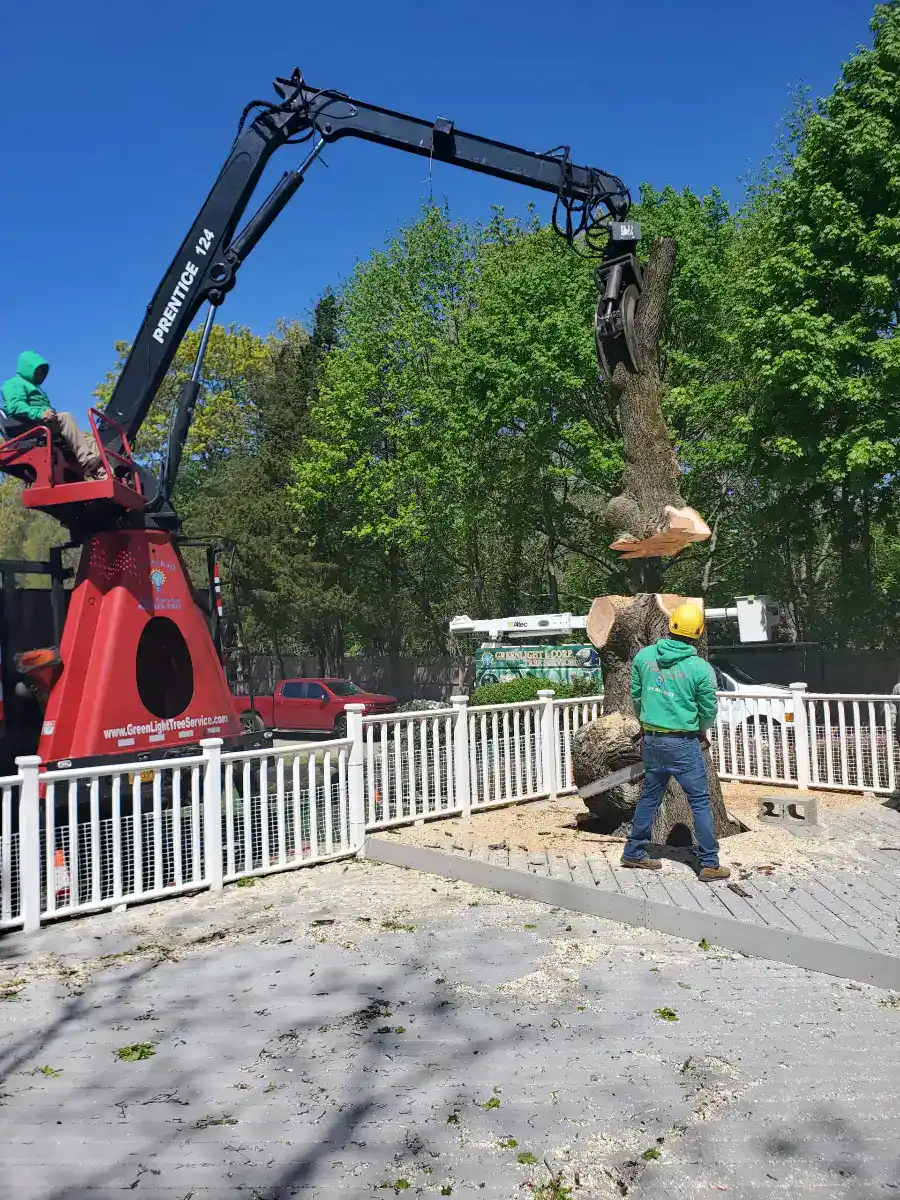
On clearing day, the usual sequence runs from the top down. Large trees come out first. Smaller trees and brush are ground or mulched, stumps are ground, and debris and rocks are moved. Then the ground is roughed out so it’s ready for the next trade. We’re a family-owned crew, and the owner is on the phone and on site, so questions don’t disappear into a dispatch line.
How Long Does It Take To Clear A Lot For New Construction In Suffolk County?
The crew time is usually the short part. Professional clearing often runs one to two days, longer for bigger or denser sites. A quarter-acre of scrub oak and brush is a different job from two acres of mature hardwoods on a slope, but in both cases the work itself moves faster than the paperwork and scheduling around it.
The real timeline looks more like this: In fall you pull the survey, check the covenant and wetland questions, and file for a permit if your lot needs one. You get quotes and settle what “cleared” means. Then clearing happens in the winter window, and the lot is handed to your builder before spring work picks up. Running that in the right order is how a closing or a builder’s start date stays intact.
Weather plays a part too. Dry or frozen ground is easier on the soil, while heavy rain leaves ruts and invites erosion. Winter is also when grinding frozen brush tends to go smoothly. On the other side, nor’easters and hurricane cleanup can pull crews away without much notice, so the earlier you book, the less you’re competing with a storm.
One thing to settle with your builder before we start: what they need the lot to look like. Do stumps need to be fully out? Is mulch left on the ground a problem? Forestry mulching leaves a layer of material that may need to be removed before building. A five-minute call to your builder can save you from clearing the lot twice.
How Do I Compare Land Clearing Quotes In Suffolk County?
Start by making sure every quote covers the same job. One contractor includes stump grinding and hauling everything away. Another leaves the stumps and chips the brush on site. Both call it “lot clearing,” and the second one looks cheaper. If a quote comes in unusually low, check whether stump grinding and debris removal are actually in it.
A solid estimate spells out which trees are coming down, what happens to the stumps, whether debris is hauled off or chipped, whether grading is included, and what erosion control the site gets. Cost drivers include how dense and mature the trees are, slope, wet ground, access, structures on the lot, and how far the material has to travel to be disposed of.
For rough context, national ranges run from $1,397 to $6,174 per acre, averaging about $3,778 according to Angi. Long Island typically runs higher than the national average. One Nassau County contractor puts debris hauling at roughly $100 to $800 extra, which shows how much that single line can move a total. Your actual price depends on your lot, which is why we price after a walkthrough, not over the phone.
Also ask for proof of insurance. You want general liability and workers’ compensation, and a certificate you can actually see. We’re fully licensed and insured, and certificates are available on request.
After that, read the reviews. On our tree jobs, customers keep coming back to the same things: we showed up on time, hauled everything away, and left the yard blown clear. For a lot you’re about to hand to a builder, that cleanup matters as much as the cutting.
Ready To Clear Your Lot In Suffolk County?
The short version: check your parcel against the Brookhaven permit rule or your own town’s, find out whether the Pine Barrens, a covenant, or wetlands come into play, and plan for the December-to-February window. Then get quotes that cover the same scope, so you can compare them fairly.
Green Light Tree Services is family owned and operated, in business for over 17 years, and based in Huntington Station. We work with homeowners and builders throughout Suffolk County, including Huntington, Islip, Riverhead, Greenport, and New Suffolk. If you’ve got a wooded lot and a build date you’d like to keep, reach out to Green Light Tree Services. We’ll walk the property with you, tell you what we see, and put the scope in writing so there are no surprises at handoff.