
Summary:
You would think “can I cut down my own tree?” would have a simple answer. In Suffolk County, it does not. Search it and one site says every tree in Smithtown needs a permit, another says anything under five inches is fine, and a third quotes rules that turn out to belong to Brookhaven, Georgia. That is not much help when you are staring at a leaning oak with a quote on the kitchen table.
We have watched homeowners get tangled up in Suffolk County tree removal rules for years. Below, you will find what the town codes say, where the answer depends on your lot, and what to check before anyone starts a chainsaw. First, the part most people get wrong.
There Is No Single Suffolk County Tree Removal Permit And Each Town Makes Its Own Rules
Here is the short version: there is no single Suffolk County tree removal permit. The county is made up of ten towns, specifically Babylon, Brookhaven, East Hampton, Huntington, Islip, Riverhead, Shelter Island, Smithtown, Southampton and Southold, and each one writes its own rules. Plenty of incorporated villages add their own on top.
This is why advice from a neighbor a few miles away can be flat wrong for your yard. A Huntington homeowner deals with tree-size tiers. In Islip, the law is mostly about written owner consent. Out east, Southampton and Greenport bar clear-cutting, and Riverhead and Southold have been drafting residential tree codes, so what is true this year may shift next year.
Whatever you read here, including this page, treat your town or village hall as the final word.
How Huntington Measures Trees And When You Need A Permit
Huntington rules live in Chapter 186 of the town code, and they are the most structured of the bunch. You need a permit to remove, destroy or substantially alter any Landmark, Large or Medium tree, or more than three Small trees or woodland within one year.
The part that trips people up is how size is measured. Huntington uses trunk circumference, which is the distance around, taken 4.5 feet above the ground. A Large tree is 113 inches or more around, which works out to roughly 36 inches across. A Medium tree starts at 32 inches around, which is only about 10 inches across. Grab a tape measure, wrap it around the trunk, and divide by 3.14 to get the diameter. A lot of ordinary yard trees in Huntington land in “Medium” and need a permit.
There are exemptions, including work under an approved plan with a building permit, utility work, emergencies, and farms and nurseries. Trees on town land or in the public right-of-way are a separate matter, and you cannot prune or remove them without written permission. The tree in front of your house may not be yours to cut.
The application asks for your Suffolk County Tax Map number, photos, owner consent, and the contractor’s Suffolk County Home Improvement Contractor license number. Fees run from about $25 to $200 and processing takes around 10 to 20 days. Permits are valid for one year. Confirm current fees and timelines with the Town of Huntington before you plan around them.
Smithtown, Islip And Brookhaven: Three Different Approaches To Tree Removal
Smithtown is where the online advice gets loudest. Chapter 285 makes it unlawful to remove or substantially alter a tree on real property without a permit. A separate clause says nobody may cut any tree, living or dead, on public or private land without the owner prior written consent, and crews have to show that consent to Suffolk County Police or town enforcement if asked. Plenty of blogs blur those two rules into “every tree, always.” The code also lists exemptions, such as legally established nurseries, utility repairs, and subdivisions approved before the ordinance. One Smithtown arborist notes that a residential parcel that cannot be subdivided further may not need a permit at all. Because that turns on the code definitions, call the Town of Smithtown before you cut.
Islip works differently. Chapter 57, the Tree Law, dates to 1982 and is mainly a written-consent rule aimed at stopping theft and wanton cutting. Land clearing is the bigger trigger there, since the zoning code says a permit has to be obtained before clearing. If you are in a village inside Islip, ask the village too.
Brookhaven keys on lot size, not tree size. The Town Tree Clearing Permit is required for residential property of two acres or more, counting contiguous lots under the same ownership. It is also required for commercial property without an approved site plan and for subdivisions without an approved clearing plan. You apply online through the Planning Division, with photos and a survey less than ten years old. Wetlands can mean a separate town permit, and disturbing more than an acre can bring in a stormwater plan.
Be careful with Brookhaven guides that quote inch cutoffs and per-year tree limits. Those come from Brookhaven, Georgia, not Long Island.
Storm-Damaged And Hazard Trees In Suffolk County: Emergency Rules And Documentation
Nor’easters and coastal storms are hard on Long Island trees, and our soils let them go over whole, roots and all. When one is across the driveway or leaning on the roof, nobody wants to hear “wait three weeks for a permit.”
Some towns plan for that. Huntington exempts emergencies, and there is no permit fee when a qualified arborist documents that a tree is dead, dying or hazardous. But owner-consent rules in places like Smithtown and Islip do not disappear because the weather turned ugly. Photograph everything before anything moves, and if power lines are anywhere near the tree, leave it alone, since LIPA has to be involved. We answer emergency calls around the clock for exactly these moments.
Do I Need A Permit To Remove A Dead Tree On Long Island?
Sometimes not, but “it is dead” is not a magic phrase. Most codes care about documentation. In Huntington, a dead, dying or hazardous tree backed by a qualified arborist written assessment can mean no fee, but the paperwork still matters. In Smithtown and Islip, a dead tree still needs the owner prior written consent before it is cut. If you rent, that means your landlord signature, and if you co-own, it means everyone who owns it.
Take photos before work starts, from a few angles, showing the dead limbs, the lean, or the rot at the base. That record helps a town reviewer see what you saw. It also protects you if a neighbor calls the Town later.
Then there is what happens when removal goes ahead without checking. An older Huntington instruction sheet showed the fee tripling when work started before the permit, and fees have likely changed since. Beyond fees, fines, stop-work orders and replanting requirements add up fast. Villages can be even stricter than towns. A Muttontown resident in Nassau County was fined about $22,500 over tree removal in a village that regulates trees of seven inches or more. That is Nassau, not Suffolk, but villages here can work the same way.
If you are not sure if your address sits inside a village, find out before you schedule anyone. The village rule can override what you assumed from the town code. And if the tree is on the line between your yard and a neighbor, get the neighbor agreement in writing before you start.
Who Pulls The Permit, And What Should You Ask Before You Sign A Contract?
Do not assume the tree company handles it. Legally, the owner carries most of the exposure, and the written consent has to be available on the job site if an officer asks. So ask directly: which town or village rules apply to my address, who files, and who is responsible if the Town says no? If a contractor waves it off with “you do not need a permit for that” without asking where you live, that is a red flag.
Ask about licensing too. Suffolk County treats tree work as home improvement, and Huntington application asks for the contractor license number, so check what your town requires. Ask for proof of insurance as well, and get the estimate in writing. A Bay Shore man was arrested after taking cash deposits for tree jobs he never did, including $350 down on a $900 job. A low quote with cash up front is where trouble starts.
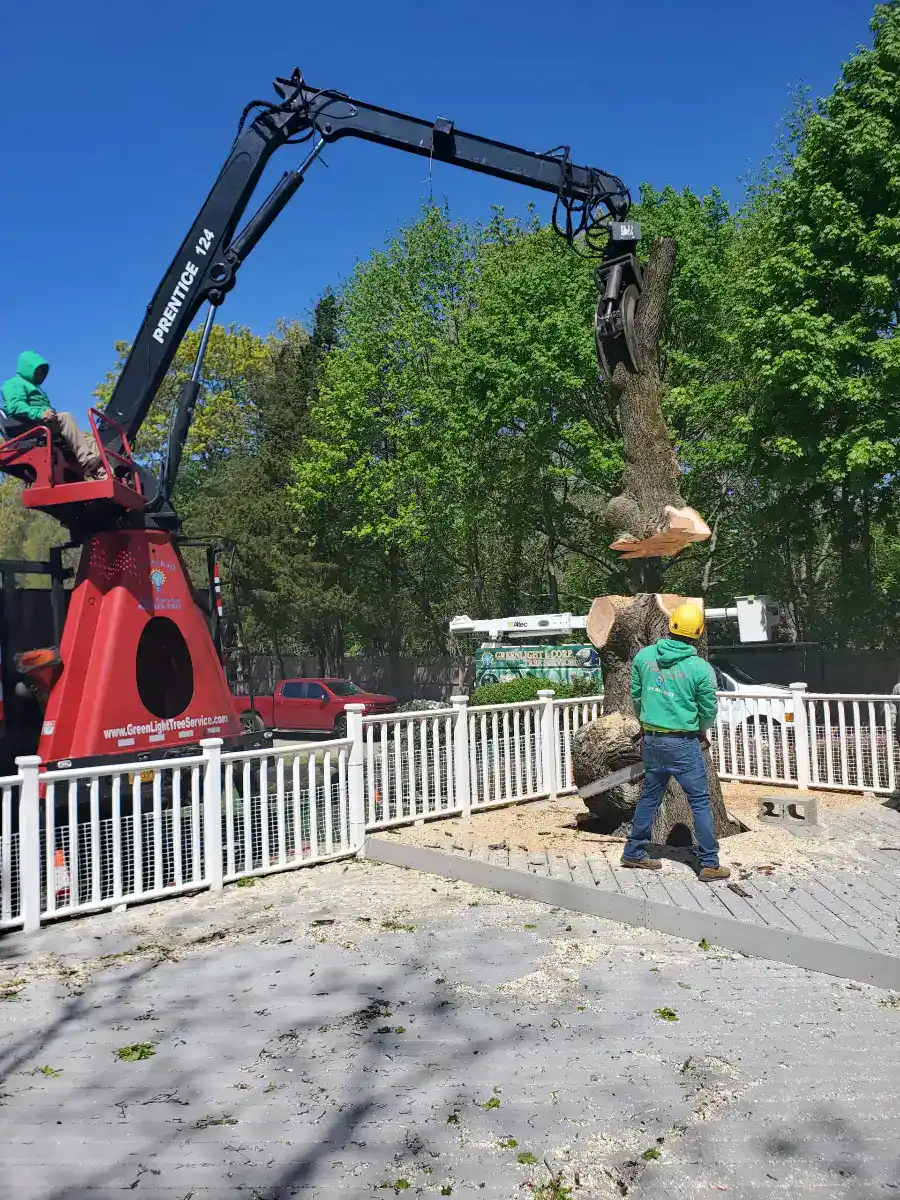
We are fully licensed and insured, with over 17 years of experience, and every job starts with a free written estimate with no hidden fees. We use tarps and barriers to protect landscaping, bring cranes for large trees near structures, and clean up completely before we leave. One customer had a 60-foot spruce pine very close to the house taken down with no damage. That is the standard we hold ourselves to.
If you are weighing a removal, call us and we will talk through the tree, your town, and what to confirm with the town office before the job goes on the calendar.
Check Your Suffolk County Town Tree Removal Rules Before The First Cut
The takeaway is simple, even if the rules are not. There is no countywide permit, so your answer depends on your town, your village, your lot and the tree itself. Huntington measures trunk circumference. Smithtown and Islip lean hard on written owner consent. Brookhaven cares about two-acre lots and clearing plans. Storm or hazard trees get some breathing room, but only if you document them.
Confirm with your town or village hall, then hire someone who gives you straight answers and a written price. If you are in Huntington, Smithtown, Islip, Brookhaven or anywhere else in Suffolk County and you would like a second set of eyes on your tree, reach out to Green Light Tree Services today to schedule your free consultation.