Summary:
You asked a tree company about stump removal, and the quote that came back says “grinding.” Now you’re wondering whether you’re getting the budget version of the job or paying for more than your yard needs. Around Suffolk County, people use those two terms as if they mean the same thing. They don’t, and the difference decides what’s left in your yard when the crew pulls out. We’ve worked with homeowners from Huntington to Hampton Bays and sorted through the confusion. Here’s how the two methods compare, how deep grinding goes, and what happens to the roots, so you can match the job to what you want that spot to become.
What Suffolk County Homeowners Really Mean By "Stump Removal"
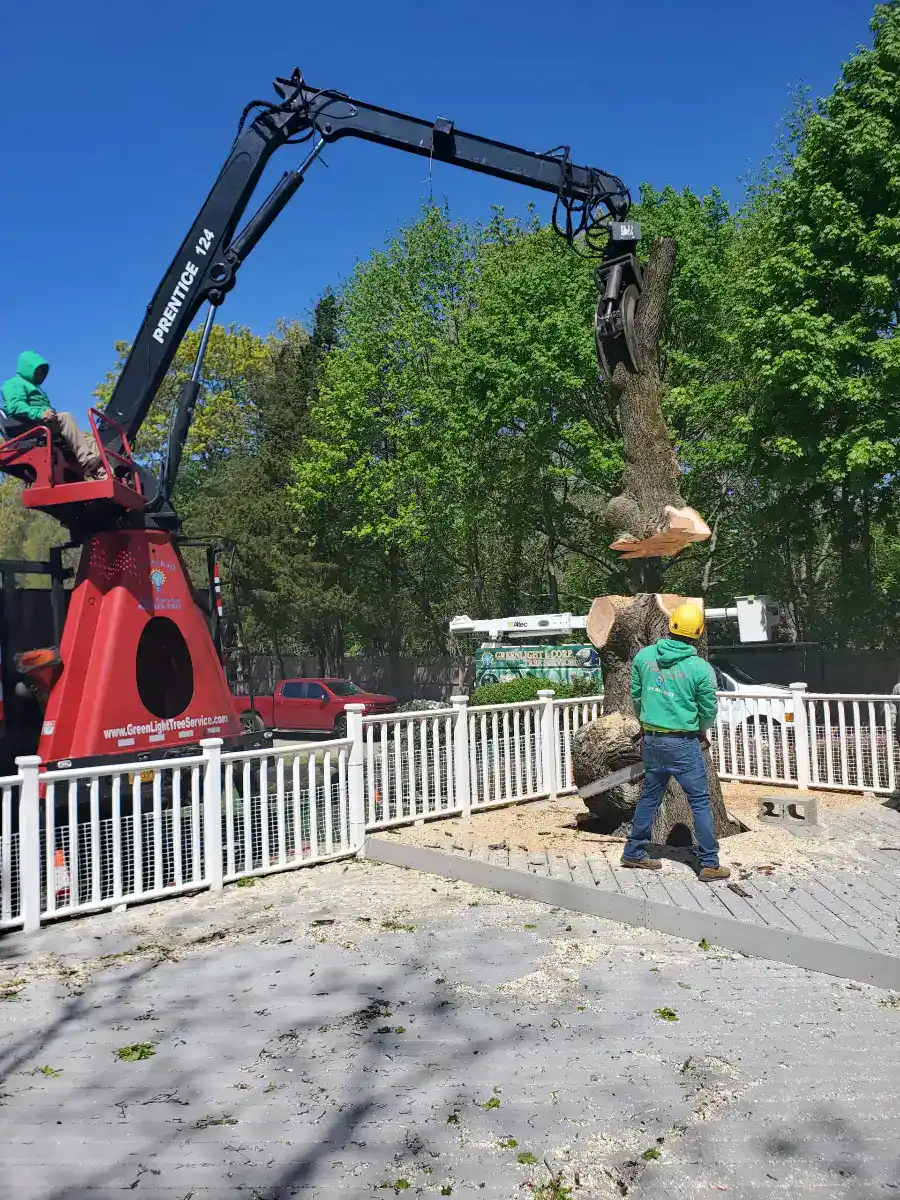
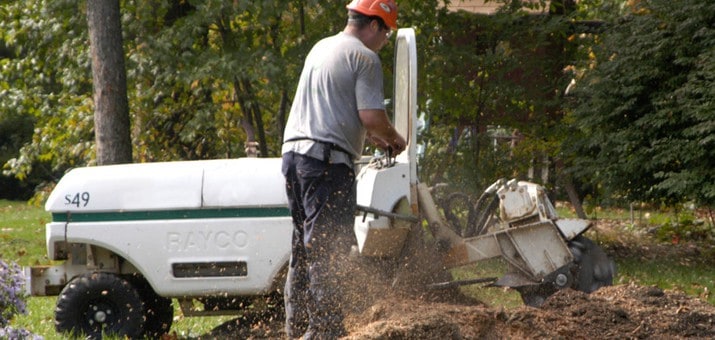
“Stump removal” is what almost everyone types into Google, and it’s what most of us say out loud. But nearly every residential job called stump removal across Suffolk County is actually stump grinding. A grinder shreds the stump into chips, down below the soil line, and the roots stay in the ground.
True stump removal means digging out the stump along with its root ball. It’s a bigger operation, it leaves a much larger hole, and it’s the right call less often than people assume.
So when you ask for stump removal, add one follow-up: do you mean grinding, or digging it out? A good estimate says which one, and says how deep. If yours doesn’t, ask before you say yes.
How Deep Does Stump Grinding Go?
Most stumps get ground to about 4 to 12 inches below ground level, and 6 to 8 inches is the figure you’ll see cited most often. That’s plenty if all you want is grass growing over the spot. Really, though, depth is a question about what you plan to put there, so it’s worth deciding that before the grinder shows up.
For a lawn or flower bed, 6 to 8 inches does the job. A new tree or a patio calls for closer to 10 to 12 inches. If the spot sits near a shed pad, a foundation, or any other structure, you may be looking at 12 to 18 inches. We’d rather hear your plan up front than guess, because grinding a second time is a headache nobody needs.
Then there’s what’s in the way. Fences, concrete, brick, rock, pools, and other trees’ roots all limit how deep a grinder can safely go, and a typical Suffolk County backyard packs several of those into a small space. Sprinkler lines, buried wiring, and hoses are easy to forget about, so we look for irrigation and underground lines before the machine starts. Our equipment is built to work in tight spaces, which means a narrow side gate usually isn’t a dealbreaker.
Most grinds take anywhere from about 30 minutes to a few hours, depending on the stump. Afterward, you can keep the chips for garden beds or we’ll haul them away. One local note: much of Suffolk County has sandy, glacially formed soil that drains fast and compacts easily. A filled-in grind hole can settle over the following months, so good backfill and a topping of quality topsoil before reseeding saves you a bare, sunken patch later.
When Is Full Stump Removal Worth It On A Suffolk County Lot?
Digging a stump out makes sense in a narrower set of situations. If you’re building something and want the main root mass gone from that footprint, if you’re worried about root disease, or if you’re planting another large tree in the exact same spot, pulling the stump and root ball can be the better call. Even then, “full removal” generally takes out the stump and the main roots, not every fine root in the soil.
The tradeoff is disruption. Excavation leaves a big crater to backfill, and on a fenced North Shore lot in Huntington or Greenlawn where you’ve spent years on the lawn, that’s a lot of yard to put back together. If equipment can’t get in, the work shifts to slower hand methods.
What does it cost? Local sources quote grinding as adding roughly $100 to $450 to a tree removal job, and full removal at about $200 to $700 for an average stump. Treat those as ranges homeowners across Suffolk County tend to see, not as our quote. Stump size, the number of stumps, access, and depth all move the number. One thing catches people off guard: stump work is usually priced as its own line item, separate from taking the tree down. Doing both in the same visit saves you a second trip and a second quote.
Two other questions come up a lot. Chemical stump removers speed up decay, but they take weeks to months, and the stump usually still has to be dealt with afterward. Renting a grinder can work for a small stump, but a large one is a different story if you’ve never run the machine.
Removing Tree Roots After Tree Removal: What's Left Under Your Suffolk County Yard
Behind most stump calls sits the real worry: once the tree is gone, what about the roots? Grinding doesn’t take them out. The stump gets chewed down, and the roots that spread out from it stay in the soil and slowly break down.
For plenty of yards, that’s perfectly fine. Roots sitting below the surface don’t bother a lawn, and many of the mature oaks and maples across Suffolk County leave a lot of root behind. Where it starts to matter is when you plan to dig, plant, or build right there. That’s the moment to decide on a deeper grind or an excavation, before the first shovel goes in.
How Far Do Tree Roots Spread After Stump Grinding, And Will They Grow Back?
Roots commonly reach 4, 8, even 12 feet or more beyond the stump, depending on the species and the size of the tree. After grinding, they decay on their own, and that usually takes roughly 5 to 10 years, sometimes longer for a big tree. You won’t get a clean, root-free patch. You’ll have a network that slowly softens and turns into soil.
That timeline matters most on older lots across Suffolk County, where big trees stood close to the house, a fence, or a driveway. Larger trees mean larger root plates, and the roots of neighboring trees may be tangled in with them. If you’re planning work near that spot, tell whoever gives you the estimate, because it changes the depth we’d recommend.
Will the tree grow back? Usually not, since grinding removes the stump itself. But some species can send up sprouts from roots left in the ground. If shoots appear, they can be cut back. We’d rather tell you that now than let you believe a ground stump is guaranteed to stay dead.
One more detail people rarely hear: if a stump was infected with honey fungus, the grindings shouldn’t be spread in your garden beds as mulch. They should be hauled away instead. If you know the tree was sick before it came down, say so when you call, and we’ll plan the cleanup around it.
Can I Plant A New Tree Or Build A Patio Where A Stump Was Ground?
Yes, with a little planning. If the spot is going back to lawn, the job is simple: grind, backfill, add topsoil, and seed. Expect some settling in our sandy Suffolk County soil and plan on a touch-up.
A new tree is different. Fresh grindings and decaying roots can affect a new planting, so ask for a deeper grind, around 10 to 12 inches, and talk through soil replacement and timing before you buy the tree. For a patio, shed, or anything with weight on it, the depth goes up, and sometimes we’ll tell you full removal makes more sense for that footprint. We’d rather say so than grind to the minimum and leave you with a problem later.
That conversation is the heart of our free estimate. We come out and look at the stump, check access and fences, look for irrigation and underground lines, and put the grinding depth and cleanup in writing. Whether the stump sits in a tight Babylon backyard or on a larger East End property in Greenport or Hampton Bays, the first question is the same: what do you want this spot to be?
Stump Removal Near Me In Suffolk County: Getting The Right Job For Your Yard
Here’s the short version. Most “stump removal” in Suffolk County is grinding, which handles most yards in a few hours and leaves the roots to decay over roughly 5 to 10 years. Full removal is the exception, worth it when you’re building, replanting a large tree in the same spot, or dealing with root disease. Depth should follow your plan for the space, and a good estimate puts that depth in writing.
We’re Green Light Tree Services, a family-owned company based in Huntington Station with nearly 20 years in the business. We’re fully licensed and insured, and any company you hire should be willing to show proof of insurance straight from the insurer. Our customers tend to mention the cleanup, and one described the yard as “blown clear.” We hold a 4.9 rating on Birdeye, and we’d like to keep earning it job by job.
If you’re searching for “stump removal near me” in Suffolk County and want someone to look at your yard before you commit, call us at 631-923-3033. Tell us what you’re hoping to do with the spot, and we’ll tell you honestly which approach fits. No pressure, and no extra work you don’t need.