Summary:
Most Nassau County homeowners don’t think much about their trees in summer. The yard looks full and green, the shade feels great, and it’s easy to assume everything is fine. But summer is actually one of the most stressful seasons a tree can face — heat, drought, humidity, pests, and the constant threat of a fast-moving storm can all take a serious toll before you notice anything is wrong. By the time the damage is visible, you’re often dealing with something that could have been prevented. This guide covers what to watch for, what to do, and what to avoid during the hottest months of the year on Long Island.
How to Spot Tree Health Problems During a Long Island Summer
Trees don’t send obvious distress signals. Most of the time, stress builds quietly underground and inside the trunk long before it shows up in the canopy. But there are early signs — if you know what you’re looking for.
Slight wilting during the hottest part of the afternoon is normal. Trees lose water through their leaves faster than their roots can replace it on a 95°F day, and they’ll often recover overnight. What’s not normal is finding those same droopy, curled leaves still there in the morning. That’s your first real indicator that something is off.
From there, the progression moves quickly. Leaf edges start browning or scorching — usually on the south and west-facing sides of the tree that take the most direct sun. Then comes premature leaf drop, visible branch dieback, and in serious cases, bark cracking. If you’re seeing any of the later-stage symptoms, the tree needs a professional eye, not just a garden hose.
Why Nassau County Trees Face More Summer Stress Than Most People Realize
There’s a combination of factors at work on Long Island that makes summer harder on trees here than in many other parts of the country. Nassau County’s densely developed communities — Garden City, Rockville Centre, Levittown, Hempstead — experience what’s called the urban heat island effect. Pavement, rooftops, and reduced green space absorb and radiate heat, pushing ambient temperatures higher than the surrounding region. A tree sitting in a tight suburban lot is dealing with more heat stress than the same species would face in a rural setting.
Then there’s the soil. Nassau County’s ground is the product of glacial deposits, and it varies significantly across the county. Sandier soils in parts of Nassau County drain faster than clay-heavy soils, which means trees in those areas can dry out more quickly between waterings. If you’re watering on a schedule designed for clay soil and your yard is sitting on sand, your trees may be thirstier than you think.
Coastal exposure adds another layer. Communities along the south shore — Long Beach, Island Park, Freeport, Baldwin, Atlantic Beach — deal with salt spray from the Atlantic Ocean and Great South Bay. Salt air can cause leaf scorch and bark damage in tree species that aren’t adapted to coastal conditions, compounding whatever heat and drought stress is already present. It’s a combination you won’t find in generic tree care guides written for a national audience, and it’s why local knowledge matters when you’re trying to keep a Nassau County tree healthy through July and August.
On top of all that, summer is when invasive pests are most active. The emerald ash borer has been spreading into Nassau County since it was first detected in Suffolk County in 2018. The spotted lanternfly is now established on Long Island. Both are most active in summer, and both tend to target trees that are already weakened by heat and drought stress — which makes the combination especially dangerous for a tree that’s struggling.
Summer Pruning in Nassau County: What to Do and What to Leave Alone
This is one of the most common mistakes we see. A homeowner looks up at their tree in July, notices it’s looking a little overgrown or messy, and decides summer is a good time to clean it up. It’s an understandable instinct — the tree is in full leaf, you can see exactly what’s going on up there, and the yard is getting daily attention. But heavy pruning during summer is genuinely harmful to most trees, and it’s worth understanding why.
When you remove healthy branches, you create wounds. In cooler months, the tree has the energy reserves to compartmentalize that damage and begin healing. In summer, those same reserves are being used to manage heat, maintain hydration, and support a full canopy of leaves. A significant pruning job on a hot August day forces the tree to redirect energy it doesn’t have to spare, and it also exposes interior wood and bark to direct sun that was previously shaded — which can cause sunscald.
The right approach for summer is to limit pruning to branches that are already dead, visibly damaged, or actively hazardous. A dead limb hanging over your roof or your driveway in Massapequa or Merrick doesn’t need to wait until fall — that’s a safety issue and should be addressed immediately. But the structural shaping, the crown thinning, the major work that improves a tree’s long-term form — that belongs in late winter or early spring, before bud break, when the tree is dormant and has the full growing season ahead to recover.
One exception worth knowing: maples and birches are generally better pruned in late summer rather than spring, because spring pruning causes excessive sap bleeding in those species. If you’re unsure about timing for a specific tree on your property, that’s exactly the kind of question we can answer in about five minutes.
Tree Maintenance Basics That Make a Real Difference in Summer Heat
Once you understand what’s stressing your trees, the next question is what to actually do about it. The good news is that the most effective summer tree care comes down to a few fundamentals done consistently and correctly. Watering and mulching aren’t complicated — but there’s a right way and a wrong way, and the wrong way is surprisingly common.
Getting these basics right won’t just help your trees survive the summer. It can lower your soil temperature, cut your water use, and reduce the risk of losing a mature tree that adds real value to your property. In North Shore Nassau County towns, a healthy mature tree can add 5 to 15 percent to a home’s value. That’s not a small number when you’re talking about a property in Great Neck or Manhasset.
How to Water Trees Correctly During a Long Island Drought
The single most common watering mistake is also the easiest to fix: most homeowners water too often and not deeply enough. A quick daily sprinkle keeps the top inch of soil moist, but tree roots go far deeper than that. Shallow watering trains roots to stay near the surface, where they’re more vulnerable to heat and drought. What trees actually need is deep, infrequent watering that pushes moisture down into the root zone where it can do real work.
A useful guideline that we use is based on trunk diameter. For a newly planted or recently transplanted tree, plan on about 5 gallons of water per inch of trunk diameter per watering session. For established trees under 10 years old, that number goes up to 10 gallons per inch. For a mature tree — the kind of 60- or 70-year-old oak that’s been shading a Syosset or Wantagh backyard since the neighborhood was first developed — you’re looking at approximately 20 gallons per inch of trunk diameter. A mature tree with a 20-inch trunk needs roughly 400 gallons of water per deep watering to get what it actually needs. That’s a very different picture than a garden hose running for a few minutes.
During a drought, plan on watering every 7 to 14 days rather than daily. Before you water, push a long screwdriver 6 to 8 inches into the soil near the root zone. If it slides in easily, there’s still adequate moisture. If you meet resistance, it’s time to water. And timing matters: the best window is early morning, between 4 and 8 AM, when evaporation is minimal and the water has time to soak in before the heat of the day. Overhead sprinklers that wet the foliage midday waste water and increase the risk of fungal disease.
For Nassau County homeowners with sandier soil — more common in parts of the county than many people realize — you may need to water more frequently than the 7-to-14-day guideline suggests. Sandy soil drains fast, and a tree sitting in it can dry out significantly faster than one in a loamier yard a few miles away.
Mulching Around Trees in Summer: What Actually Works (and What Causes Damage)
Mulch is one of the most effective tools in summer tree care, and one of the most misused. Done correctly, a layer of organic mulch around your tree’s root zone can lower soil temperature by up to 20 degrees Fahrenheit and reduce water loss by as much as 50 percent. On a 95-degree August afternoon in Nassau County, that’s a meaningful difference for a tree’s root system. Done incorrectly, mulch can cause rot, disease, and long-term structural damage that isn’t visible until serious harm has already been done.
The right depth is 2 to 4 inches of organic mulch — wood chips, shredded bark, or similar material — spread out to the tree’s drip line, which is roughly the outer edge of the canopy. That’s where the feeder roots are most active, and that’s where the mulch does the most good. You want to cover as much of that root zone as you reasonably can.
What you don’t want to do is pile the mulch against the trunk. This is called volcano mulching, and it’s everywhere in Nassau County neighborhoods. It looks intentional, even decorative, but it traps moisture directly against the bark, which promotes rot and fungal disease. Over time, it can also encourage girdling roots — roots that grow in a circle around the trunk rather than outward, slowly cutting off the tree’s ability to move water and nutrients. A tree can look completely healthy on top while girdling roots are doing serious damage below the soil line. Keep mulch at least 3 to 6 inches away from the trunk, always.
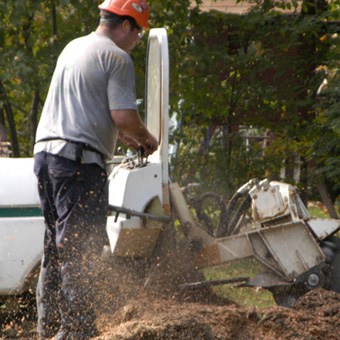
One more thing worth mentioning here: old stumps left in the yard can harbor fungal diseases and attract wood-boring insects that spread to nearby healthy trees. In summer, when your trees are already managing heat and drought stress, a diseased stump nearby is an additional vulnerability they don’t need. Stump grinding eliminates that risk entirely and is worth considering as part of a broader summer tree health strategy — not just a cosmetic fix.
When to Call a Certified Arborist in Nassau County, NY
Watering correctly, mulching properly, and knowing what not to prune will carry your trees a long way through a Long Island summer. But some things genuinely require a trained eye. If you’re seeing signs of moderate to severe heat stress, unexplained leaf drop, visible pest damage, or any branch that concerns you heading into storm season — which runs from June through November on Long Island — it’s worth having a professional take a look before a problem becomes an emergency.
Nassau County’s hurricane season is real, and a structurally compromised tree near your home is a liability that gets more expensive with every storm that passes. A pre-season assessment from an ISA Certified Arborist can tell you exactly what’s at risk, what can wait, and what needs to be addressed now.
We’ve been working with Nassau and Suffolk County trees for nearly 20 years. Our ISA Certified Arborist, Miguel Quintanilla (Certification #NY-6680A), brings a level of credentialed expertise that most tree service operators in this market simply don’t have. We offer free estimates, and we’re available 24/7 for emergency situations. If your trees are telling you something this summer, we’re happy to help you figure out what it is.