
Summary:
A tree is leaning toward your roof, or half of it is bare in June, or a storm already put it on your lawn. So you search for the town of Huntington tree removal permit rules and get a code book, a thin Town page and a dozen contractor blogs that mix up Nassau and Suffolk County. Here’s the plain version. Suffolk County has no countywide tree permit, so every town writes its own, and Huntington’s asks for real documentation. We’re a Huntington Station tree service, and we’ll walk you through what the Town actually wants, starting with the question that trips up most homeowners: how big is your tree?
Do You Need A Permit To Remove A Tree In Huntington, NY?
Maybe, and it depends on the tree as much as the address. Chapter 186 of the Town Code covers the unincorporated parts of the Town of Huntington. If you live inside an incorporated village, you follow the village’s rules instead. Lloyd Harbor, for one, runs its own permits through a Village Arborist. And because Suffolk County has no countywide system, what worked for a friend in Brookhaven or Smithtown doesn’t carry over.
Inside the Town’s jurisdiction, you need a permit to remove or substantially alter any Landmark, Large or Medium tree, or more than three Small trees or any Woodland within a one-year period. The Code also requires the property owner’s written consent before anyone cuts, damages or removes a tree, living or not, standing or down. Applications go through the Planning Department at Town Hall (Room 212) and now run through the Town’s online permit portal.
How To Measure A Tree For A Huntington Tree Permit
Wrap a soft tape measure around the trunk 4½ feet above the ground. Huntington goes by that circumference, not the width. Under 32 inches around is a Small tree. From 32 inches up it’s Medium, and 113 inches or more is Large. Divide by three for a rough width: 32 inches around is a trunk about 10 inches across, and 113 inches is closer to 36 inches across.
Here’s what surprises people. A 10-inch trunk is nowhere near a giant, and it still needs a permit. Small trees get more room, since you can remove up to three in a one-year period without one. The fourth changes that, and so does clearing a wooded patch. That count adds up fast when you’re opening up a back corner of the yard for a patio or a play area.
Landmark Trees work differently because they’re defined by status, not size. A tree can qualify if it’s rare or endangered, listed on New York State’s Big Tree List, a state or U.S. champion, or previously designated a historic landmark. Even a smaller specimen of a small species can count if it’s outstanding. If you suspect you have a landmark tree in Huntington, such as one that’s been a neighborhood fixture for decades, check before you plan anything.
Ordinary pruning isn’t what the Code is after. “Substantial alteration” is regulated, though, so if the plan is a major cut-back rather than a tidy-up, ask the Planning Department before you start.
Dead Tree Removal In Huntington: Do You Still Need A Permit?
This is where most of the confusion lives. Plenty of people assume a dead tree is a free pass. The Code does treat dead, dying and hazardous trees more favorably, but it doesn’t take your word for it. A tree counts as dead or dying when an official of the Town or an arborist certified by the International Society of Arboriculture (ISA) determines it, and the Code says that may need photos or resistograph readings to back it up.
The Town’s own application instructions spell out the practical side. If an ISA Certified Arborist determines a tree is dead, dying or hazardous, the fee is waived, but the application still has to include the arborist’s letter and photos. So the dead tree removal permit in Huntington doesn’t disappear. It gets cheaper, as long as it’s documented properly. “Hazardous” means imminent danger to life or property, and emergencies are treated differently, but that’s another case where you want the photos and a written assessment on file before the stump is the only evidence left.
Storms add a wrinkle. A tree already on the ground still falls under the written-consent rule, so photograph the tree and the damage before anything gets moved.
We start every estimate with an arborist looking at the tree itself. We’ll tell you straight whether it looks dead, dying, hazardous or just inconvenient, and what the letter and photos need to show. The letter has to come from an ISA Certified Arborist, so confirm who is signing it. Better to hear “this one’s healthy” now than after you’ve scheduled a removal the Town won’t approve.
Town Of Huntington Tree Permit Costs And Timeline
At the last published Town instructions, the fee is $25, nonrefundable, for every five trees or portion thereof. That file is dated 2015, and the Town has since moved applications online, so check the portal for the current amount before you budget. If an ISA Certified Arborist determines your tree is dead, dying or hazardous, there’s no fee as long as the arborist’s letter and photos are attached.
A permit is valid for one year, which gives you room to schedule the work properly instead of rushing it. The expensive mistake is timing. If removal started or finished before the permit was issued, the fee triples. That’s the one rule worth taping to your fridge: nobody lifts a saw until the approval is in hand.
Processing time is set by the Town, not by us, so build in some cushion and ask Planning where your application stands.
What To Include In Your Huntington Tree Permit Application
Most delays come from missing pieces, so gather everything before you open the portal. The application wants your name, address and signature, plus the owner’s written consent if you’re not the owner. It also asks for your address and Suffolk County Tax Map Number, the circumference and location of each tree, and photos of the trees, including views toward the neighboring properties.
You’ll also need a survey or color aerial of the lot with each tree marked by an X, and every tree needs flagging tape so Town staff can find it on inspection. Walk the yard with a roll of tape and your phone before you start. When the tape on the trunk, the photo and the X on the survey all match, you avoid a lot of back-and-forth.
Huntington’s North Shore setting adds one more item for some lots. If a tree sits within 100 feet of designated wetlands, the Town wants a DEC Letter of Non-jurisdiction or Approval. That letter comes from the state, so get it started early.
There are exemptions, too. Work that follows an approved landscaping, grading, drainage or clearing plan under a building permit is one. Removal within 25 feet of a proposed building, drainage structure or driveway, where there’s no landscape plan, is another. If your tree removal is part of a construction project, tell your builder, because the exemption depends on what’s on file.
Choosing A Tree Removal Company In Huntington That Handles Permits Right
Most hiring guides skip a detail that matters here. The Huntington application asks for the contractor’s name, address, signature and Suffolk County Home Improvement License number. The company you hire becomes part of your paperwork. A cutter who can’t give you a license number can’t help with the application, and a crew that starts before approval puts you in triple-fee territory.
Before you sign anything, ask what their Suffolk County Home Improvement License number is, and whether they can send an insurance certificate from their carrier covering both general liability and workers’ comp. Ask who handles the permit and whether that costs extra, and whether they’ll wait for the approval before starting. You should get clear answers to all of it.
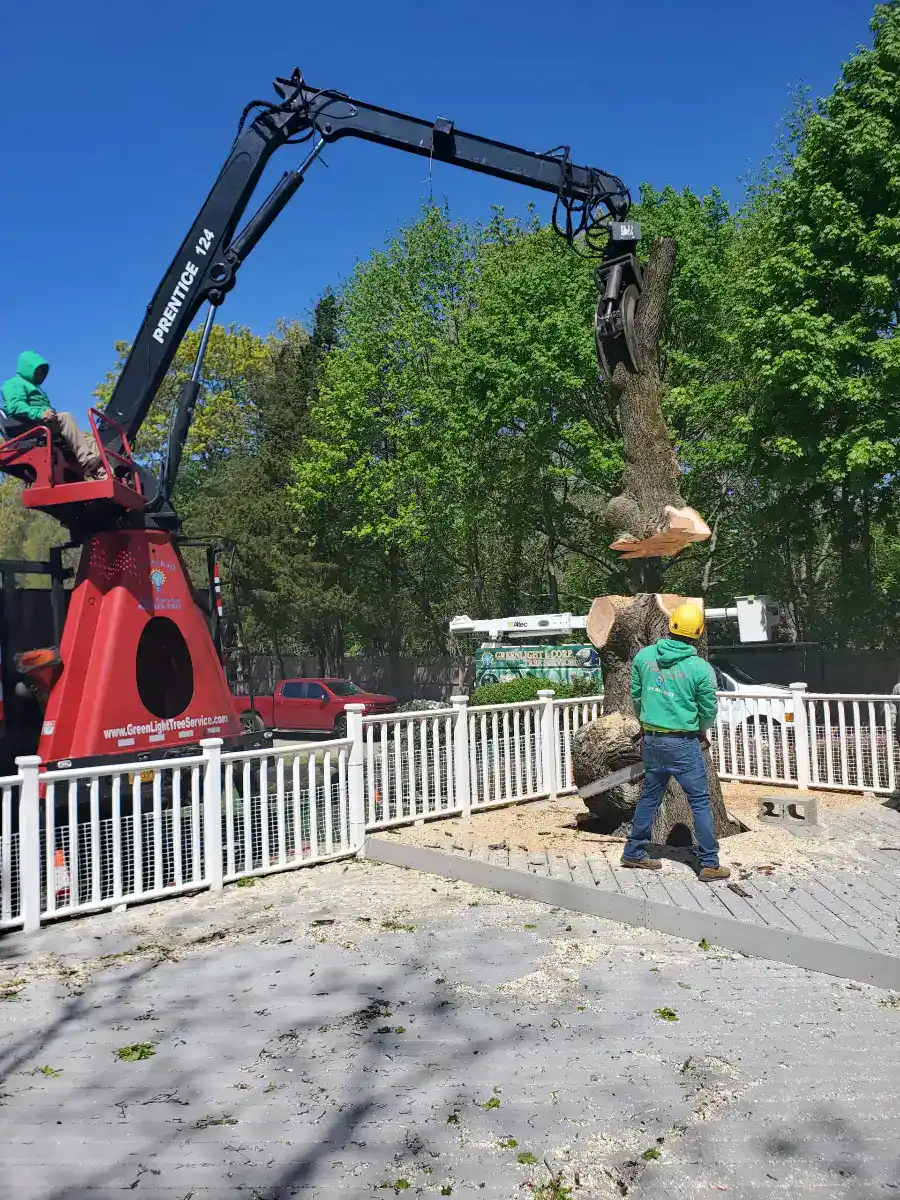
We’re a family-owned, owner-operated tree service in Huntington Station, and we’ve been at it for over 17 years. We’re fully licensed and insured, and we start with the tree, not the sales pitch. That means an arborist’s look at the free estimate, a straight answer on whether the Town needs to be involved, and an agreement on who does what before we schedule anything. We don’t start cutting until the approval is in hand.
The work itself matters too. Customers have described a 60-foot spruce close to a house coming down with no damage, and yards left so clean it was “like they were not even here.” That’s the standard we hold ourselves to, whether it’s tree removal in Huntington Station or anywhere else in the Town of Huntington.
Ready To Remove A Tree In Huntington? Start With The Permit Question
Measure the trunk 4½ feet up, count your small trees, and think about whether you could have a Landmark Tree. Remember that a dead tree still needs documentation, even when the fee is waived. Get your tax map number, survey, photos and flagging tape together, and don’t let anyone cut before the permit is issued. The Town’s Planning Department has the final word on all of it, so use its page and portal to confirm the current details.
If you’d like a second set of eyes on the tree first, Green Light Tree Services is a short call away in Huntington Station. We’ll look at it, tell you what category it likely falls into, and lay out the next steps without pushing you toward a removal you don’t need. And if a storm has already made the decision for you, we handle emergency tree work around the clock.